Treating Varroa Mites with Heat
Heat treatment for varroa mites is achieved using Thermosolar Hives. One thing is certain: It’s a promising new weapon for a very serious problem.
Reading Time: 5 minutes
What temperature kills varroa mites? Treating varroa mites with heat is a different tactic that uses special hive components to employ a passive solar radiation technique.
In 1987, varroa mites were discovered in the United States and caused panic among beekeepers and researchers. Their fears were well-founded. Eradication proved ineffective and the mites inexorably spread across the continent. Without any innate resistance among honeybees, even the most organic-minded beekeepers were forced into using chemical solutions to save their hives, as these mites aren’t succumbing to extermination. The best a beekeeper can hope for is to keep the mites to a level that won’t decimate the hive.
Varroa mites are, unfortunately, increasing their resistance to treatments, and chemical residues are finding their way into the hive structure, including the wax and honey.
But a new type of beehive developed in the Czech Republic is taking the beekeeping world by storm — it eradicates varroa mites with a staggering 100 percent success rate. Named the “Thermosolar Hive,” it exploits a simple principle: Honeybees and varroa mites have different heat tolerances. Essentially, the new hive creates a condition of hyperthermia, which kills the mites but leaves the bees and brood unharmed.
Life Cycle of Varroa Mites
To understand how heat kills varroa mites, a brief explanation of their life cycle is necessary.
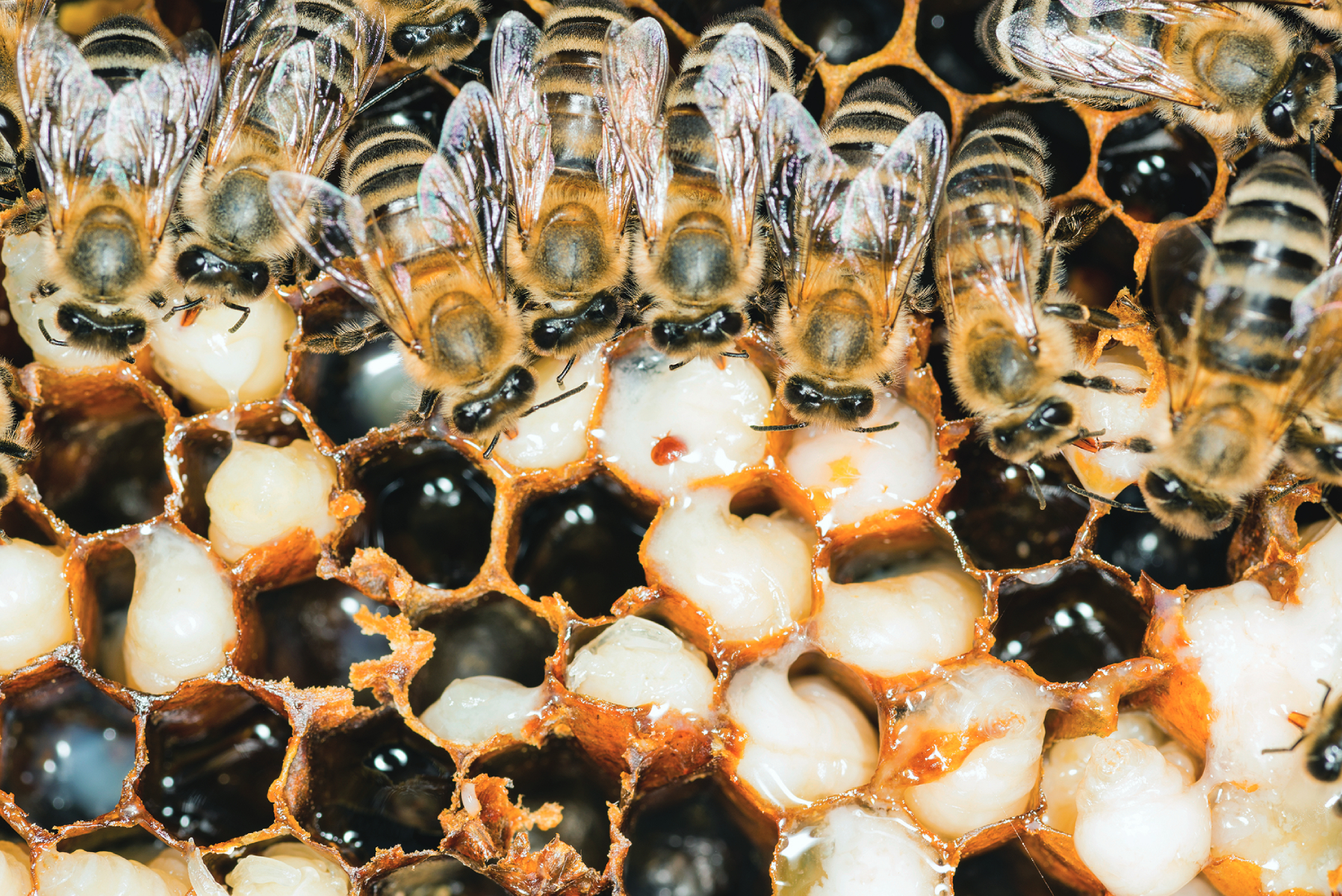
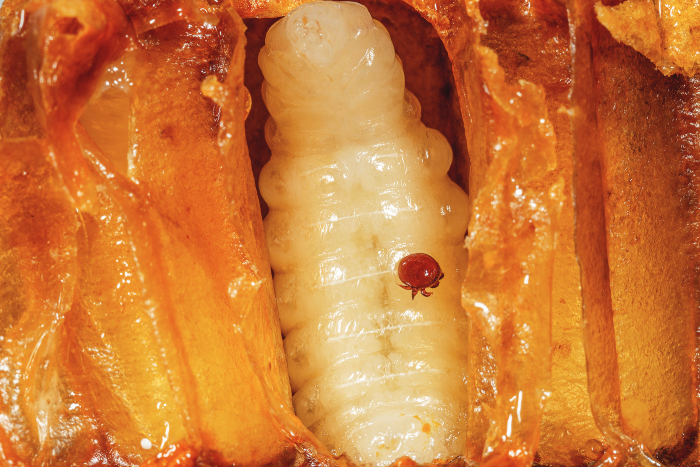
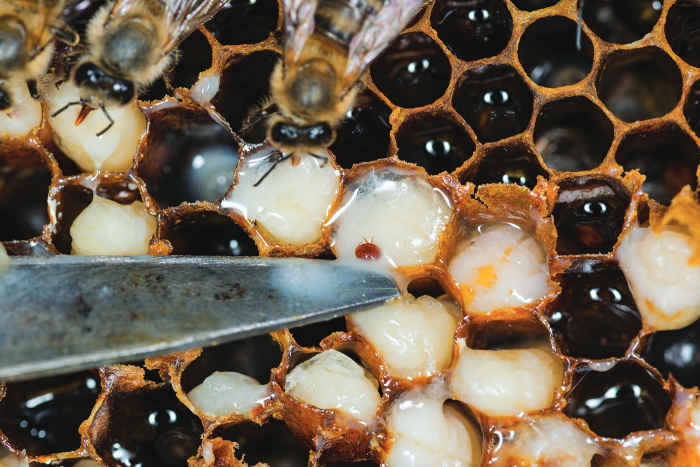
Varroa mites reproduce only on bee brood. A female mite will enter the brood cell before it’s capped and burrow into the larval food at the bottom of the cell. She emerges once the cell is capped to feed on the developing bee’s body fat.
The mother mite lays up to six eggs at intervals of about 30 hours. The first egg develops into a male, and the rest develop into females. Mite development from egg to adult takes 8 to 10 days. The male mates with the female mites as they mature. The male mite and any undeveloped daughter mites die within the brood cell.
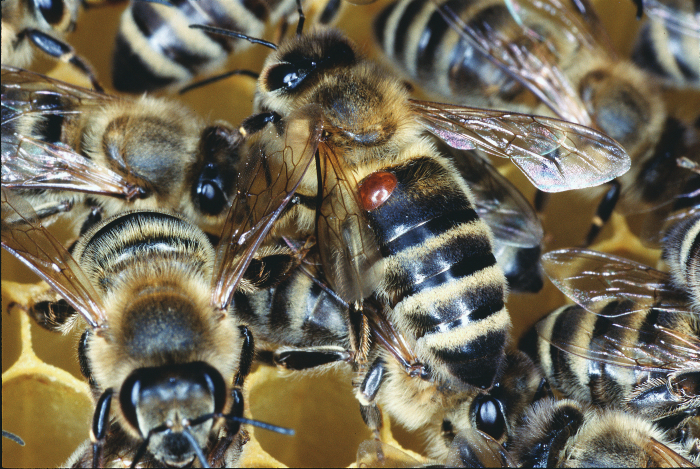
The mother mite and her mature daughters then climb onto nurse bees (which attend the brood) and are transferred to adjoining brood cells to begin the reproductive cycle again. During heavier mite infestations, several mites might infest one brood cell. As long as bee brood is present, mites can have between 24 and 30 breeding cycles per year, with each female breeding up to three times each. The result is an exponential growth curve.
Because varroa mites prefer drone brood over worker brood, during the times when bees are raising large numbers of drones, varroa mite infestations can explode.
Research reveals that 80 to 85 percent of mites are found in capped brood, with most (but not all) of the remaining number on nurse bees. A few mites are found on forager bees, which are used as
a means of transport to colonize new hives.
Treating Varroa Mites with Heat
Thermosolar hives are a modification on the classic Langstroth system, with a lid, supers, brood boxes, etc. The difference is that the hive is engineered to passively capture solar radiation and raise the temperature to a state of hyperthermia. The hives use thermosolar panels on the ceiling and sides to transfer heat inside. The hives are thermally insulated in the honey chambers and bottom, so heat accumulates and is retained for the amount of time necessary to kill the varroa mites.
What Temperature Kills Varroa Mites?
By transforming solar radiation into thermal energy, hive temperature is raised to between 104 degrees Fahrenheit and 116 degrees F (40 degrees Celsius and 47 degrees C) over a period of 2 to 3 hours — a level lethal to mites but harmless to bees or brood. Temperatures above 98.6 degrees F (38 C) for two hours will damage the mites’ reproductive organs, which makes further reproduction impossible. Above 104 degrees F, the mites’ physiological metabolism is disrupted and they die. The careful use of intense short-term blasts of heat is being called “thermotherapy.”
Since female varroa mites parasitize the capped bee brood, the brood boxes are placed highest in the hive during thermotherapy sessions. Nurse bees have less chitinized bodies than older worker bees, so they’re able to cool down faster and tolerate higher temperatures. Any mites on the nurse bees are killed by the heat treatment for varroa mites while leaving the bees unharmed.
Honeybees famously can warm or cool their hive environment as needed. The Thermosolar Hive is built to overcome the bees’ cooling ability. The bees can ventilate hot air, but not the heat waves emitted into the brood chamber by the thermosolar panel. Once above 104 degrees F, the less heat-tolerant worker bees move to the bottom of the hive, while the nurse bees remain to take care of the brood. The nurse bees also maintain the necessary humidity in the brood chamber during a thermotherapy session.
The hive is supplied with thermometers so the beekeeper can monitor the temperature. Too little heat, and the mites won’t be killed off. Too much heat, and the honeybees will die as well. The 104 degrees F to 116 degrees F window is crucial.
Thermotherapy shouldn’t be performed with a queen excluder or caged queen in the hive. The queen must be present in the hive during the thermotherapy.
The only varroa mites that survive the initial treatment are the ones already attached to foraging bees that are outside the hive. For complete effectiveness, the thermotherapy session should be repeated a second time, 10 to 12 days later. After that, maintenance treatments 2 to 3 times per season are sufficient to keep varroa mites eradicated. Not controlled, but eradicated.
Because Thermosolar Hives use sunlight, they need to be placed in a sunny south or southeast-facing location. Thermotherapy sessions should be done on days with a minimum temperature of 68 degrees F and a maximum of 30 percent cloud cover. For purposes of even temperature distribution, sessions should be done in the mornings (not afternoon).
Thermal Mite Killer
The development of a passive solar radiation technique to control varroa mites is nothing short of revolutionary. This technique requires no chemical applications, leaves no contaminating residues, requires no external power source, and allows beekeepers to obtain organic certification. Additionally, it’s physiologically impossible for the mites to develop resistance to high temperatures, as happens with chemical controls.
Of course, no system is perfect. Thermosolar Hives are pricey, somewhere on the order of $750 apiece (depending on the components requested, such as number and size of hive boxes, etc.). They’re heavier than standard hives and have parts that are breakable. Because thermotherapy sessions must be carefully monitored, they’re more suited to small-scale beekeepers than massive commercial enterprises with thousands of hives scattered in multiple locations. Standard hives can’t be retrofitted with thermosolar components.
The use of Thermosolar Hives is a compromise in the search for varroa mite control, balancing cost with results. One thing is certain: It’s a promising new weapon for a very serious problem.
Originally published in the May/June 2026 issue of Countryside and Small Stock Journal and regularly vetted for accuracy.