Giant Honeybee Shimmering Bee-Havior
"Let's do the wave!"
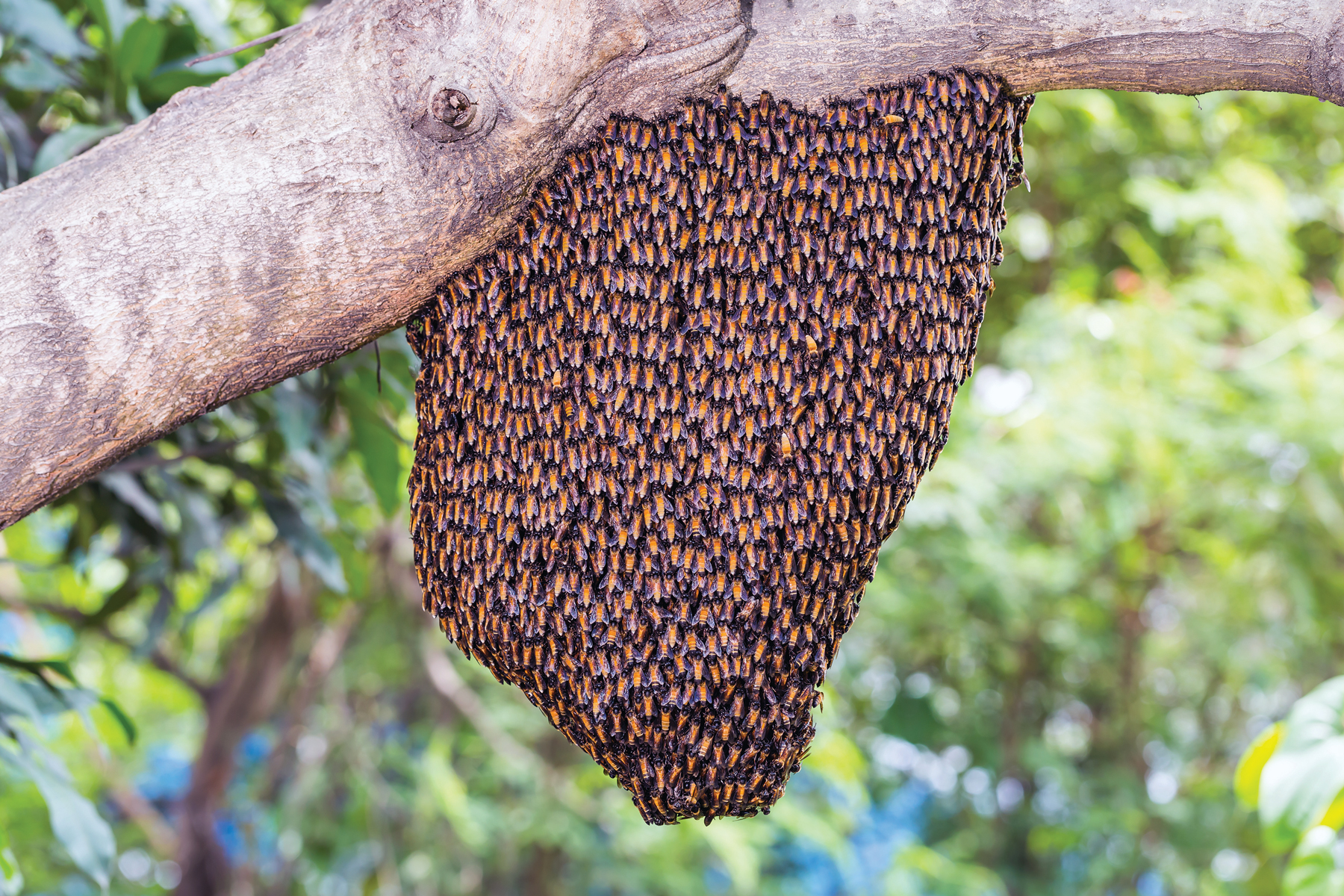
Learn about the giant honeybee shimmering behavior as a defense strategy to ward off predatory wasps and hornets.
Giant honeybees (Apis dorsata) are a species of large, tropical, undomesticated honeybee, native to Southeast Asia. They’re known for building nests in exposed places high off the ground, including tree limbs, cliff overhangs, and building eaves. Nests typically take the form of a single vertical comb in a semicircular shape up to 5 feet across, and are covered in a dense mass of up to 100,000 bees in multiple layers.
Because these nests are out in the open, the bees have developed aggressive defense strategies and won’t hesitate to attack anything that disturbs the nest. Despite this, Indigenous people have harvested honey and wax from giant honeybees for centuries, possibly millennia. Some nests can yield up to 100 pounds of honey.
Typical non-human predators of giant honeybees include wasps, hornets, and birds. Giant honeybees don’t hesitate to sting, as a defense mechanism. They also form “heat balls” as a defense against wasps and hornets, in which they mob the predator, heat their thoraces with flight muscles, and achieve a temperature inside the ball of 113 degrees Fahrenheit, which is lethal to their attackers.
Giant honeybees also use an astounding additional tactic to repel wasps and hornets called “shimmering.” Imagine, if you will, an “audience wave” in a crowded stadium in which thousands of people throw up their arms with timed coordination to create a wave effect across the stadium. This is comparable to what giant honeybees do, in fractions of a second, across the width of their nests. The result is strobe-like, darker lines that can take any number of intriguing patterns. Even moving spirals have been observed. It seems incredible that such effects can happen in nature.
Shimmering is done by the outer layer of bees, which will thrust their abdomens upward at a 90-degree angle and shake them in synchrony with neighboring bees, creating a ripple effect across the face of the nest.
“Shimmering starts at distinct spots on the nest surface and then spreads across the nest within a split second. Whereby hundreds of individual bees flip their abdomens upward,” note the authors of “Social Waves in Giant Honeybees Repel Hornets,” published in PLOS One. The behavior is mesmerizing to watch.
This shimmering behavior serves a critical function: Predatory wasps that attempt to snatch a single bee from the nest become confused and leave the nest alone.
To determine how the shimmering effect works to repel predators, scientists filmed hundreds of wasp-bee interactions with high-speed film, then analyzed the footage, frame by frame. The results showed how the rate of the bees’ shimmering is modulated by the hornets’ flight speed and proximity, which in turn creates a “shelter zone” of around 20 inches that prevents the predatory wasp or hornet from plucking bees directly off the nest’s surface. Shimmering is a key defense strategy that supports the giant honeybee’s open-nest lifestyle.
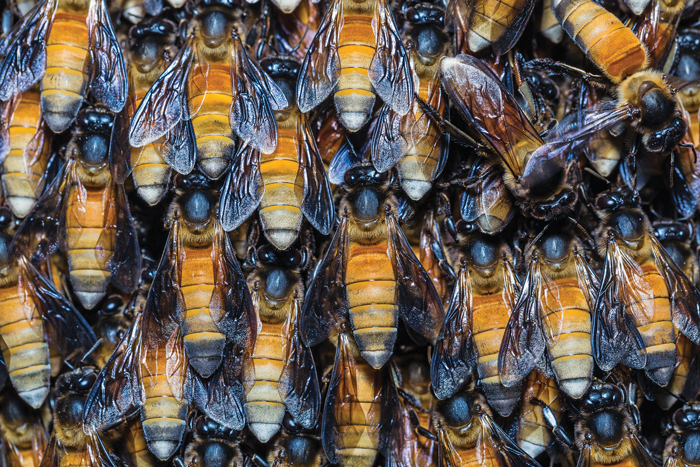
The behavior can be described as “big-scale” shapes and “small-scale” shapes. Big-scale shimmering repels wasps within a specific range of the nest. Small-scale shimmering prevents wasps from preying on specific bees, by generating visual confusion.
Shimmering is a form of defense that doesn’t require contact with the predator, which minimizes risk to defending bees. While shimmering is particularly effective against wasps and hornets, it also acts as an impressive deterrent to birds or even mammals (including humans). As fascinating as the behavior is to see, it’s the colony’s equivalent of shouting “Keep away or we’ll attack!”
Wasps and hornets are attracted to honeybee nests for their rich resources (protein and sugar). However, in thousands of observed episodes across several honeybee colonies, not a single case of a successful hunt (wasp catching a bee on the nest surface) was observed. Clearly, shimmering works.
But wasps have another predatory tactic, namely attempting to catch unprotected foraging bees while they’re away from the shelter zone of the nest. In this case, the solitary bees’ defensive tactic is to dodge and fly away with maximum speed or land as fast as possible on the nest. When the pursued bee is within a short range of the nest, the shimmering behavior of the colony works to repel the wasp. The wasps’ hunting success with this strategy is about 3 percent, meaning they succeed in catching the occasional solitary bee. This rate isn’t much of a loss to the bee colony, but represents a benefit for the wasp … which is why the wasps keep coming back.
Studies under simulated conditions have shown that shimmering behavior is strongest when bees see a dark object moving against a light background, i.e., a wasp or hornet under daylight conditions. When the contrast was flipped — when the bees were shown a light object against a black backdrop —shimmering wasn’t triggered. This suggests that either the predators aren’t as active at night, or the bees engage in different defensive behaviors during low-light conditions.
Avian predators (birds) don’t elicit shimmering. Instead, the bees will engage in mass-stinging behavior if attacked by birds. In fact, controlled studies have shown that shimmering isn’t triggered by anything above a certain size threshold (over 4 centimeters in diameter), suggesting that it’s limited to wasps and hornets, but not birds or other predators.
How does shimmering happen? How can bees communicate with each other the need to shimmer? The behavior is triggered close to the periphery of the mouth zone of the nest, suggesting that specialized bees in each colony initiate shimmering. In addition to flipping their abdomens up and shaking them synchronously, the behavior may be accompanied by stroking of the wings of neighboring bees, which is thought to transmit the signal to nearby workers to also adopt the posture, thus creating the visible ripple effect across the face of the comb.
Why do giant honeybees shimmer at all? While it’s clear that shimmering is a less-risky defensive strategy for the bees (because there’s no physical contact with the predators), why don’t the wasps or hornets just ignore the behavior and pluck bees off the nest surface? At this point, that question can’t be answered. Scientists have only been able to determine that wasps and hornets can’t seem to ignore or habituate to shimmering of the bees. As a first line of defense against predators, shimmering has proven to be effective.
Scientists are only scratching the surface of this coordinated behavior. But shimmering is yet another example of extraordinary animal communication, specifically how one species (giant honeybees) can communicate a warning to another species (wasps or hornets) that they’ll defend themselves. Nature is amazing.
Resources
https://pmc.ncbi.nlm.nih.gov/articles/PMC2528003/
www.sciencenews.org/article/giant-honeybee-shimmering-nest-behavior-defense
https://journals.biologists.com/jeb/article/225/17/jeb244716/276503/Defensive-shimmering-responses-in-Apis-dorsata-are
https://link.springer.com/article/10.1007/s00114-009-0605-y
https://edis.ifas.ufl.edu/publication/IN1119
Patrice Lewis is a wife, mother, homesteader, homeschooler, author, blogger, columnist, and speaker. An advocate of simple living and self-sufficiency, she’s practiced and written about self-reliance and preparedness for almost 30 years. She’s experienced in homestead animal husbandry and small-scale dairy production, food preservation and canning, country relocation, home-based businesses, homeschooling, personal money management, and food self-sufficiency.
Originally published in the September/October 2025 issue of Countryside and Small Stock Journal and regularly vetted for accuracy.